Wednesday, August 18, 2010
Farewell
Hello everyone. Today I write with a bit of news...I will no longer be working at the Helen Louise Allen Textile Collection. I have very much enjoyed my time here and have been lucky to work with such a great collection. Thank you all for following along and for having such interest in the HLATC and our relocation.


Friday, July 23, 2010
Moroccan Slippers

HLATC 1985.14.6, Slippers (babouches), Morocco, 1975-1985
One of my most recent photography projects was a group of footwear from Morocco. This heavily decorated pair of slippers (babouches) was likely created for wear at a special occasion, such as a wedding.

Notice how the slippers don't have backs, very similar to shoes we would call "mules." These slippers were made by the Berber people, traditionally a Muslim culture. The shoes not having backs is likely to allow for easy removal upon entering the Mosque for daily prayer.
An added benefit of backless shoes is allowing for more air circulation, keeping the wearer cool in the heat of Morocco!

Tuesday, June 8, 2010
Technology Enhanced Learning

HLATC LKOPO98, String Bag (bilum), New Guinea, Early to mid 20th century.
Some of our recently added database images were taken as part of the UW Technology Enhanced Learning Project. Artifacts selected, in collaboration with faculty member Diane Sheehan, for inclusion in the project were geared towards the Design Studies course in Off-Loom Textile Construction. Photos of the selected textiles were taken by the DS Department's very own Lori Ushman and the textiles were also researched and cataloged in detail by Betsy Tuttle. The end result is a great subset of the collection for the Off Loom Textile Construction students to work with, allowing them to closely analyze the textile's structure and techniques prior to seeing the piece in person. It also has the fringe benefit of making the pieces available for everyone else as well, browse the entire set here.
Learn more about this bilum string bag from New Guinea here and read a little about the meaning behind the bilum here.


Wednesday, May 19, 2010
Imaging Project
Hello and welcome back! Now that the move is over, I have been looking for other HLATC projects to share with you here. One of our big projects for the next couple of years is to work on a backlog of imaging. It is a great advantage that our temporary storage space has a separate area spacious enough to allow us to continue photographing the collection. New images, in addition to scans of previously taken slides, will allow us to bring more of our collection to you through our online digital collection. I thought you all might enjoy it if I featured some of the pieces we photograph here on the blog. Do I hear a resounding yes?

It seems fitting to begin with a piece, LPUS427, designed and created by Helen Louise Allen herself. It is an experimental weaving from the 1960s, created as a sort of sampler of different weaving techniques. Made from bast fibers, the piece has an almost rope like texture.


It seems fitting to begin with a piece, LPUS427, designed and created by Helen Louise Allen herself. It is an experimental weaving from the 1960s, created as a sort of sampler of different weaving techniques. Made from bast fibers, the piece has an almost rope like texture.


Thursday, April 1, 2010
Worn Through

Recently Heather Vaughn of the blog, Worn Through: Apparel from an Academic Perspective, contacted us for a little interview. The blog's primary focus is the academic and museum worlds of dress studies and they recently have been exploring issues related to moving museum costume and textile collections. This is where we make our grand entrance! I was excited to share more information about the HLATC relocation with the Worn Through community. Please check out their blog as well as the HLATC feature. Thanks to Heather and Worn Through for the opportunity!
Friday, March 12, 2010
Now what?

So our first move is complete and you might be wondering...now what? Well, we have a lot of work to do before our second move! I'm certain the next move back into our brand new building in a couple of years will be here before we know it. Planning that move back into our new permanent storage location will likely be more involved since we won't have the luxury of a year of unpacking, which is about how long we had for the packing. Laying out permanent storage configurations and assigning permanent locations will also be a huge and very time intensive part of this final move project.
In the meantime, I will also be doing a lot of photography of our collection, in addition to planning our new storage and classroom spaces and a lot of curatorial catchup.
I imagine this blog space will evolve into something a little different than just a move blog until we're back in the thick of moving. So, I thought I'd ask you, our readers, what would you like to see?? I'd love your input. Feel free to comment below or email me directly at zlatanovski@wisc.edu


Monday, February 15, 2010
Move Recap #1

Rich Reinke and Linda Zwicker, still smiling!
Okay we are back up and running here at the HLATC. Hooray! I will get right to sharing the fun photos of our move days with you. First up, the moving of the rolled textiles.

The oversized rolls, covered in tyvek, were removed from their wooden racks and were carefully secured on the moving truck individually. Thankfully, this did not represent the majority of our rolled textiles. Most were able to be moved in groups within their storage racks. The tubes were secured onto the racks (as you've seen illustrated in earlier posts) and the full racks were inserted into custom made, covered moving carts, which were then secured on the truck.

Those carts were then moved over to our new space and the emptied into the custom built temporary racking system while waiting for the cabinets to be brought over.

Bringing the cabinets over is where things got interesting. We're not sure how the cabinets made it into our tiny storage space many years ago, but it was fairly evident that they weren't coming out through the usual door we use to access the space. The door into our storage area had a tight turn to get out and there was no chance the cabinets were going to be able to make that turn.
So once the room was entirely emptied of textiles, we came to what we'd been excitedly planning for: the day we knock the wall down. In reality, it ended up being the day the UW Physical Plant staff cuts out the door frame, which wasn't quite as exciting and dramatic, but much cleaner and less disruptive.

Our storage space had in fact been three separate rooms at some point in the building's past and those additional doorways remained in the hallways. Once the space became HLATC textile storage, those doors directly into the hallway were locked and blocked off by cabinets. It turns out, we just needed to widen one of those doorways just a little bit and the oversized cabinets could make it through.

And down the stairs it goes!

Once our metal cabinets were also carefully maneuvered out of the building and installed at the new storage space, the regular rolled textile racks were then taken out of the temporary shelving and placed back in their metal cabinets.

Tuesday, January 19, 2010
Mission Accomplished

We did it! The Helen Louise Allen Textile Collection relocation has been completed. So many people worked so hard on this project and I just want to say thank you thank you thank you for everyone's help. We couldn't have done it without you.
Blueprint Fine Art Services did a beautiful job crating and boxing our oversized pieces. The force behind the relocation, C. Coakley, did a great job and were an absolute pleasure to work with. Rich Reinke, Coakley's on-site leader for our move, was integral to the relocation going as smoothly as it did and he without a doubt deserves a round of applause. Particularly for maintaining a positive attitude for weeks on end!
I suppose I should also say thanks to mother nature for limiting the blizzards to non-move days. You've got to love these midwestern winters!
I will have many more photos of the move process as well as our new spaces just as soon as I find the box I packed the flash card reader into...
Tuesday, January 5, 2010
Things are movin'
Hello! Wow, has it really been almost a month since my last post? My apologies. As you might guess, things have gotten really busy around here. December 11th officially kicked off the HLATC move and we've made some amazing progress. I will have some great updates (with photos!) to share with you all very soon, so please stay tuned!
Friday, December 4, 2009
In the News

All photos in this post by Jeff Miller
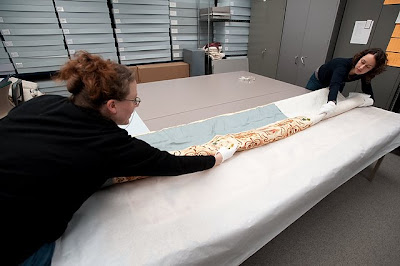
The HLATC move was recently covered in the story, A World of Textiles, a Sea of Boxes by Wisconsin Week. A big thank you to Susannah Brooks for writing the story and to Jeff Miller for the photography. Jeff came by the day we were packing the opera quilt into a box, so you can get a sense of just how large that piece really is!



Friday, November 13, 2009
Rolled Textiles

As you can tell from my less frequent posts, things are really getting busy around here! Prep work has begun for moving approximately 1,500 rolled textiles that are currently stored within cabinets. Here you can see Rich and Matt from C. Coakley working in storage.


The plan is to secure all of the rolled pieces onto their current storage racks and move the racks intact. First, those red plastic caps are inserted into the ends of the rods, eliminating the little bit of space between the rod and the bracket, so now it fits very snugly. Cable ties then secure the rod onto its brackets and the brackets onto the frame.

There are also "bumpers" being created from archival storage tubes cut to specific sizes. Those will be placed between the rolled textiles and the ends of the rod, eliminating any horizontal movement of the textiles. The racks will then be slid onto custom created rolling carts for transport. Once the cabinets are reinstalled into our new storage space, the racks will slide right back into their cabinets. Pretty creative, eh?
Thursday, October 29, 2009
Opera quilt

HLATC E1242A, Opera quilt, France, 1897-1900

Intricately embroidered vignettes decorate the front of this European bedspread, which dates to the turn of the 19th century. The amazingly detailed embroidery is credited to the hands of six French nuns, who worked diligently on the piece for three years. The level of detail is so fine that a few of the embroidered women are actually wearing real beaded necklaces.
This impressively sized bedspread (10 ft x 9 ft) is called an Opera Quilt because the scenes depicted on it are from operas playing around the time the quilt was made. The six operas represented: Boheme-1896, Manon-1884, Aida-1871, Cavall Rustice-1890 (Cavalieria Rusticana), Tosca-1900, and Strategia Damore-1896. The images used for the opera 'Tosca' were copied from a series of promotional postcards printed in Italy, probably the year of the premier, 1900. It is likely the other images are also copied from similar postcards.
The quilt is said to have won first prize at the World's Fair in Paris in November of 1900. This gives us some insight into the year the piece was created, as we know that it was finished no later than 1900. Also, since the opera Tosca did not premier until the year 1900, it is likely the quilt was begun earlier and the last vignette added was of Tosca, in 1900.


Friday, October 16, 2009
Archaeological Textiles

WFSA3091, Chancay, Peru, 1100-1400A.D.
These incredible archaeological textiles from Peru are among the oldest pieces in the Helen Louise Allen Textile Collection. The fragment shown above, WFSA3091, is absolutely breathtaking in person. The image has not been enhanced in any way, this is the true color of the textile. Dating to between 1100-1400A.D., this slit tapestry weave fragment was woven on a backstrap loom, likely by a member of the Chancay culture in the Central Coast area of Peru. Textiles are among the most fragile of artifacts, making it truly remarkable for pieces this old to have even survived, much less retained the vibrant colors of their natural dyes.

WFAS3091 detail

WFAS 3091 detail

WFSA1848, Peru, 1000-1476A.D.

1996.1.2, Paracas, Peru, 600B.C-200A.D.

WFSA3094, Chancay, Peru, 1000-1476A.D.
Friday, October 9, 2009
In the eighties

If only I was talking about the weather. Fall has descended here in the Midwest, which means it is 50 degrees and raining. It also means we have almost arrived at our big move date! The collection is now eighty percent packed. EIGHTY!! This is great news. And secretly (or not so secretly, since I'm posting it on a blog) we are actually further ahead than the numbers indicate. You might remember from my previous post that we have a significant number of rolled textiles that will not be boxed and therefore aren't being counted in our tallies. So, our progress is actually closer to 90%. Add in the handful of pieces that we are having custom boxes and/or crates built for by fine arts shippers and my goodness we're just about done! Ofcourse, it is always that last 10% that seems to take the longest, so we're not claiming victory just yet.
Here you can see Tara working with some of the rolled textiles that will actually be boxed. We are sorting them by size to make securing them within a box a little easier.


Friday, October 2, 2009
Supplies & Resources
Packing 13,000 textiles takes A LOT of supplies. To date we have used hundreds and hundreds of archival boxes in addition to thousands of sheets of acid free tissue. Tyvek, muslin, twill tape, coroplast, ethafoam, and many others have also made appearances in this packing show. Gaylord Brothers, an archival materials supplier, has been our source for all of our packing materials. If you ever need a large quantity of supplies, I highly recommend contacting their bids department. They eliminated the need to shop around for the best price on every single supply and having a great account representative has made the ordering process a breeze. Less time spent on purchasing leaves me more time to spend on packing and that's a very good thing. Many thanks to Michelle from Gaylord!
Recently, I searched for resources discussing appropriate materials to be used when packing artifacts, so I could share them with members of our move team. This online publication from the Canadian Conservation Institute is really great as is this list of materials from PACIN: the Packing, Art Handling, and Crating Information Network.


Recently, I searched for resources discussing appropriate materials to be used when packing artifacts, so I could share them with members of our move team. This online publication from the Canadian Conservation Institute is really great as is this list of materials from PACIN: the Packing, Art Handling, and Crating Information Network.
Subscribe to:
Posts (Atom)


