Monday, February 15, 2010

Move Recap #1


Rich Reinke and Linda Zwicker, still smiling!

Okay we are back up and running here at the HLATC. Hooray! I will get right to sharing the fun photos of our move days with you. First up, the moving of the rolled textiles.


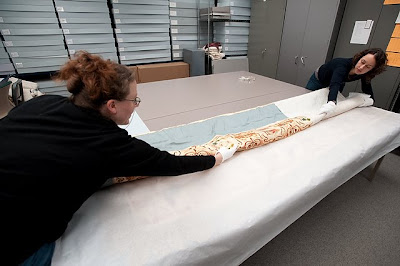
The oversized rolls, covered in tyvek, were removed from their wooden racks and were carefully secured on the moving truck individually. Thankfully, this did not represent the majority of our rolled textiles. Most were able to be moved in groups within their storage racks. The tubes were secured onto the racks (as you've seen illustrated in earlier posts) and the full racks were inserted into custom made, covered moving carts, which were then secured on the truck.


Those carts were then moved over to our new space and the emptied into the custom built temporary racking system while waiting for the cabinets to be brought over.


Bringing the cabinets over is where things got interesting. We're not sure how the cabinets made it into our tiny storage space many years ago, but it was fairly evident that they weren't coming out through the usual door we use to access the space. The door into our storage area had a tight turn to get out and there was no chance the cabinets were going to be able to make that turn.

So once the room was entirely emptied of textiles, we came to what we'd been excitedly planning for: the day we knock the wall down. In reality, it ended up being the day the UW Physical Plant staff cuts out the door frame, which wasn't quite as exciting and dramatic, but much cleaner and less disruptive.


Our storage space had in fact been three separate rooms at some point in the building's past and those additional doorways remained in the hallways. Once the space became HLATC textile storage, those doors directly into the hallway were locked and blocked off by cabinets. It turns out, we just needed to widen one of those doorways just a little bit and the oversized cabinets could make it through.


And down the stairs it goes!


Once our metal cabinets were also carefully maneuvered out of the building and installed at the new storage space, the regular rolled textile racks were then taken out of the temporary shelving and placed back in their metal cabinets.

Tuesday, January 19, 2010

Mission Accomplished


We did it! The Helen Louise Allen Textile Collection relocation has been completed. So many people worked so hard on this project and I just want to say thank you thank you thank you for everyone's help. We couldn't have done it without you.

Blueprint Fine Art Services did a beautiful job crating and boxing our oversized pieces. The force behind the relocation, C. Coakley, did a great job and were an absolute pleasure to work with. Rich Reinke, Coakley's on-site leader for our move, was integral to the relocation going as smoothly as it did and he without a doubt deserves a round of applause. Particularly for maintaining a positive attitude for weeks on end!

I suppose I should also say thanks to mother nature for limiting the blizzards to non-move days. You've got to love these midwestern winters!

I will have many more photos of the move process as well as our new spaces just as soon as I find the box I packed the flash card reader into...

Tuesday, January 5, 2010

Things are movin'

Hello! Wow, has it really been almost a month since my last post? My apologies. As you might guess, things have gotten really busy around here. December 11th officially kicked off the HLATC move and we've made some amazing progress. I will have some great updates (with photos!) to share with you all very soon, so please stay tuned!

Friday, December 4, 2009

In the News


All photos in this post by Jeff Miller

The HLATC move was recently covered in the story, A World of Textiles, a Sea of Boxes by Wisconsin Week. A big thank you to Susannah Brooks for writing the story and to Jeff Miller for the photography. Jeff came by the day we were packing the opera quilt into a box, so you can get a sense of just how large that piece really is!


Friday, November 13, 2009

Rolled Textiles


As you can tell from my less frequent posts, things are really getting busy around here! Prep work has begun for moving approximately 1,500 rolled textiles that are currently stored within cabinets. Here you can see Rich and Matt from C. Coakley working in storage.


The plan is to secure all of the rolled pieces onto their current storage racks and move the racks intact. First, those red plastic caps are inserted into the ends of the rods, eliminating the little bit of space between the rod and the bracket, so now it fits very snugly. Cable ties then secure the rod onto its brackets and the brackets onto the frame.


There are also "bumpers" being created from archival storage tubes cut to specific sizes. Those will be placed between the rolled textiles and the ends of the rod, eliminating any horizontal movement of the textiles. The racks will then be slid onto custom created rolling carts for transport. Once the cabinets are reinstalled into our new storage space, the racks will slide right back into their cabinets. Pretty creative, eh?

Thursday, October 29, 2009

Opera quilt


HLATC E1242A, Opera quilt, France, 1897-1900


Intricately embroidered vignettes decorate the front of this European bedspread, which dates to the turn of the 19th century. The amazingly detailed embroidery is credited to the hands of six French nuns, who worked diligently on the piece for three years. The level of detail is so fine that a few of the embroidered women are actually wearing real beaded necklaces.

This impressively sized bedspread (10 ft x 9 ft) is called an Opera Quilt because the scenes depicted on it are from operas playing around the time the quilt was made. The six operas represented: Boheme-1896, Manon-1884, Aida-1871, Cavall Rustice-1890 (Cavalieria Rusticana), Tosca-1900, and Strategia Damore-1896. The images used for the opera 'Tosca' were copied from a series of promotional postcards printed in Italy, probably the year of the premier, 1900. It is likely the other images are also copied from similar postcards.

The quilt is said to have won first prize at the World's Fair in Paris in November of 1900. This gives us some insight into the year the piece was created, as we know that it was finished no later than 1900. Also, since the opera Tosca did not premier until the year 1900, it is likely the quilt was begun earlier and the last vignette added was of Tosca, in 1900.


Friday, October 16, 2009

Archaeological Textiles


WFSA3091, Chancay, Peru, 1100-1400A.D.

These incredible archaeological textiles from Peru are among the oldest pieces in the Helen Louise Allen Textile Collection. The fragment shown above, WFSA3091, is absolutely breathtaking in person. The image has not been enhanced in any way, this is the true color of the textile. Dating to between 1100-1400A.D., this slit tapestry weave fragment was woven on a backstrap loom, likely by a member of the Chancay culture in the Central Coast area of Peru. Textiles are among the most fragile of artifacts, making it truly remarkable for pieces this old to have even survived, much less retained the vibrant colors of their natural dyes.


WFAS3091 detail


WFAS 3091 detail


WFSA1848, Peru, 1000-1476A.D.


1996.1.2, Paracas, Peru, 600B.C-200A.D.


WFSA3094, Chancay, Peru, 1000-1476A.D.