Wednesday, August 18, 2010
Farewell
Hello everyone. Today I write with a bit of news...I will no longer be working at the Helen Louise Allen Textile Collection. I have very much enjoyed my time here and have been lucky to work with such a great collection. Thank you all for following along and for having such interest in the HLATC and our relocation.


Friday, July 23, 2010
Moroccan Slippers

HLATC 1985.14.6, Slippers (babouches), Morocco, 1975-1985
One of my most recent photography projects was a group of footwear from Morocco. This heavily decorated pair of slippers (babouches) was likely created for wear at a special occasion, such as a wedding.

Notice how the slippers don't have backs, very similar to shoes we would call "mules." These slippers were made by the Berber people, traditionally a Muslim culture. The shoes not having backs is likely to allow for easy removal upon entering the Mosque for daily prayer.
An added benefit of backless shoes is allowing for more air circulation, keeping the wearer cool in the heat of Morocco!

Tuesday, June 8, 2010
Technology Enhanced Learning

HLATC LKOPO98, String Bag (bilum), New Guinea, Early to mid 20th century.
Some of our recently added database images were taken as part of the UW Technology Enhanced Learning Project. Artifacts selected, in collaboration with faculty member Diane Sheehan, for inclusion in the project were geared towards the Design Studies course in Off-Loom Textile Construction. Photos of the selected textiles were taken by the DS Department's very own Lori Ushman and the textiles were also researched and cataloged in detail by Betsy Tuttle. The end result is a great subset of the collection for the Off Loom Textile Construction students to work with, allowing them to closely analyze the textile's structure and techniques prior to seeing the piece in person. It also has the fringe benefit of making the pieces available for everyone else as well, browse the entire set here.
Learn more about this bilum string bag from New Guinea here and read a little about the meaning behind the bilum here.


Wednesday, May 19, 2010
Imaging Project
Hello and welcome back! Now that the move is over, I have been looking for other HLATC projects to share with you here. One of our big projects for the next couple of years is to work on a backlog of imaging. It is a great advantage that our temporary storage space has a separate area spacious enough to allow us to continue photographing the collection. New images, in addition to scans of previously taken slides, will allow us to bring more of our collection to you through our online digital collection. I thought you all might enjoy it if I featured some of the pieces we photograph here on the blog. Do I hear a resounding yes?
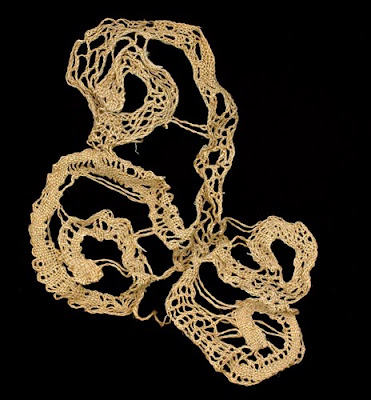
It seems fitting to begin with a piece, LPUS427, designed and created by Helen Louise Allen herself. It is an experimental weaving from the 1960s, created as a sort of sampler of different weaving techniques. Made from bast fibers, the piece has an almost rope like texture.
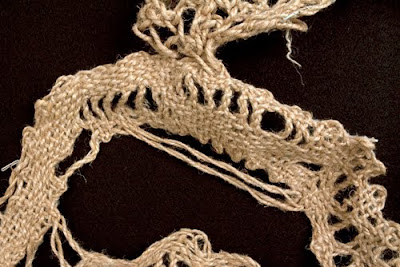
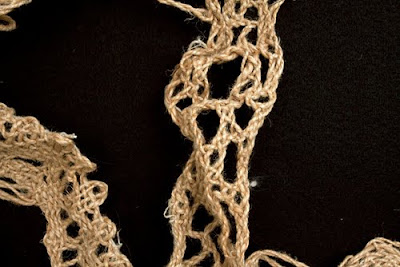

It seems fitting to begin with a piece, LPUS427, designed and created by Helen Louise Allen herself. It is an experimental weaving from the 1960s, created as a sort of sampler of different weaving techniques. Made from bast fibers, the piece has an almost rope like texture.


Thursday, April 1, 2010
Worn Through

Recently Heather Vaughn of the blog, Worn Through: Apparel from an Academic Perspective, contacted us for a little interview. The blog's primary focus is the academic and museum worlds of dress studies and they recently have been exploring issues related to moving museum costume and textile collections. This is where we make our grand entrance! I was excited to share more information about the HLATC relocation with the Worn Through community. Please check out their blog as well as the HLATC feature. Thanks to Heather and Worn Through for the opportunity!
Friday, March 12, 2010
Now what?

So our first move is complete and you might be wondering...now what? Well, we have a lot of work to do before our second move! I'm certain the next move back into our brand new building in a couple of years will be here before we know it. Planning that move back into our new permanent storage location will likely be more involved since we won't have the luxury of a year of unpacking, which is about how long we had for the packing. Laying out permanent storage configurations and assigning permanent locations will also be a huge and very time intensive part of this final move project.
In the meantime, I will also be doing a lot of photography of our collection, in addition to planning our new storage and classroom spaces and a lot of curatorial catchup.
I imagine this blog space will evolve into something a little different than just a move blog until we're back in the thick of moving. So, I thought I'd ask you, our readers, what would you like to see?? I'd love your input. Feel free to comment below or email me directly at zlatanovski@wisc.edu


Monday, February 15, 2010
Move Recap #1

Rich Reinke and Linda Zwicker, still smiling!
Okay we are back up and running here at the HLATC. Hooray! I will get right to sharing the fun photos of our move days with you. First up, the moving of the rolled textiles.

The oversized rolls, covered in tyvek, were removed from their wooden racks and were carefully secured on the moving truck individually. Thankfully, this did not represent the majority of our rolled textiles. Most were able to be moved in groups within their storage racks. The tubes were secured onto the racks (as you've seen illustrated in earlier posts) and the full racks were inserted into custom made, covered moving carts, which were then secured on the truck.

Those carts were then moved over to our new space and the emptied into the custom built temporary racking system while waiting for the cabinets to be brought over.

Bringing the cabinets over is where things got interesting. We're not sure how the cabinets made it into our tiny storage space many years ago, but it was fairly evident that they weren't coming out through the usual door we use to access the space. The door into our storage area had a tight turn to get out and there was no chance the cabinets were going to be able to make that turn.
So once the room was entirely emptied of textiles, we came to what we'd been excitedly planning for: the day we knock the wall down. In reality, it ended up being the day the UW Physical Plant staff cuts out the door frame, which wasn't quite as exciting and dramatic, but much cleaner and less disruptive.

Our storage space had in fact been three separate rooms at some point in the building's past and those additional doorways remained in the hallways. Once the space became HLATC textile storage, those doors directly into the hallway were locked and blocked off by cabinets. It turns out, we just needed to widen one of those doorways just a little bit and the oversized cabinets could make it through.

And down the stairs it goes!

Once our metal cabinets were also carefully maneuvered out of the building and installed at the new storage space, the regular rolled textile racks were then taken out of the temporary shelving and placed back in their metal cabinets.

Subscribe to:
Posts (Atom)